


The ROI of Mentorship: IYT’s Economic Impact Serving Young Men of Color
- Dec 18, 2025
- 5 min read
Updated: Dec 19, 2025

If you want to understand Improve Your Tomorrow’s (IYT) impact, start with high school graduation.
Graduating high school is one of the strongest predictors of lifetime earnings, tax contributions, workforce participation, and whether someone will ever need to rely on public systems for support. It is not simply an educational milestone—it is an economic one.
Yet for too many boys and young men of color, graduation is far from guaranteed. Nationally, Black and Latino young men graduate at significantly lower rates than their peers, with thousands leaving school each year without a diploma. These outcomes are not driven by a lack of ability. They are the result of compounding structural factors: chronic absenteeism, academic disengagement, exposure to trauma, housing instability, and the absence of consistent adult mentorship once a student begins to fall off track.
The cost of this failure is substantial. One analysis by the National Center for Education Statistics estimates that each high school dropout costs the U.S. economy approximately $272,000 over their lifetime, through lost tax revenue and increased public spending on health care, public assistance, and incarceration.
When graduation rates improve at scale, the economic returns are significant. Based on a cost-benefit analysis using national data, Improve Your Tomorrow’s graduation outcomes are projected to generate over $1 billion in net lifetime economic value through higher earnings and reduced long-term public costs.
At an average cost of $2,500 per participant, that translates into roughly $37 in economic value for every $1 invested—about a 3,600% return driven by higher lifetime earnings and reduced long-term public costs. On a per-student basis, that’s approximately $92,500 in projected economic value generated for each young man served.

IYT is intentionally designed to serve boys and young men of color who are already off track. Last year, 22% of the program's middle and high school participants reported experiencing homelessness, and 4% had been in foster care—realities that often coincide with chronic absenteeism, low GPAs, and behavioral or life challenges that place graduation at serious risk.
Marion, a senior at Cesar Chavez High School in California’s Central Valley, was one of those students. When Marion entered IYT, he had earned zero credits and held a 0.1 GPA. He was chronically absent and disengaged from school. His turnaround did not come from a single intervention or a moment of motivation. It came from consistent mentorship. Marion’s mentor, Nicole, showed up—through missed days, setbacks, and slow progress. She checked in when he disengaged, held him accountable when expectations slipped, and stayed long enough for trust to translate into performance.
Over time, Marion rebuilt every freshman credit. Today, he holds a 4.0 GPA, has completed his second undefeated football season, and is applying to universities with concrete plans for his future—from professional sports to real estate to counseling.


What happened for Marion is not an exception. It reflects a broader pattern across Improve Your Tomorrow’s programs. Last year alone, all 438 IYT College Academy members who entered IYT with GPAs below 2.0 experienced an increase of nearly 0.7 points with their average GPA being a 2.55. In one 12th-grade cohort, students improved from a 1.87 GPA as freshmen to a 2.64 GPA by senior year through IYT’s program.
This is the core of IYT’s model: belief, made operational through long-term mentorship.
The Economics of Graduation
At a national graduation rate of 81–83% for Black and Latino young men, Improve Your Tomorrow’s 99% graduation outcome represents a meaningful shift—not only in educational attainment, but in long-term economic impact.
When more young men graduate from high school, two things change in predictable ways. First, lifetime earnings increase. Second, long-term public costs decline. Together, those changes create measurable economic value.
To understand the scale of that value, IYT conducted a conservative benefit analysis focused on a single, well-documented comparison: earning a high school diploma versus leaving school without one. This approach mirrors the methodology used in national cost-benefit studies of education and service programs, including analyses of AmeriCorps and Senior Corps, which estimate economic impact by comparing outcomes under different scenarios using publicly available data.
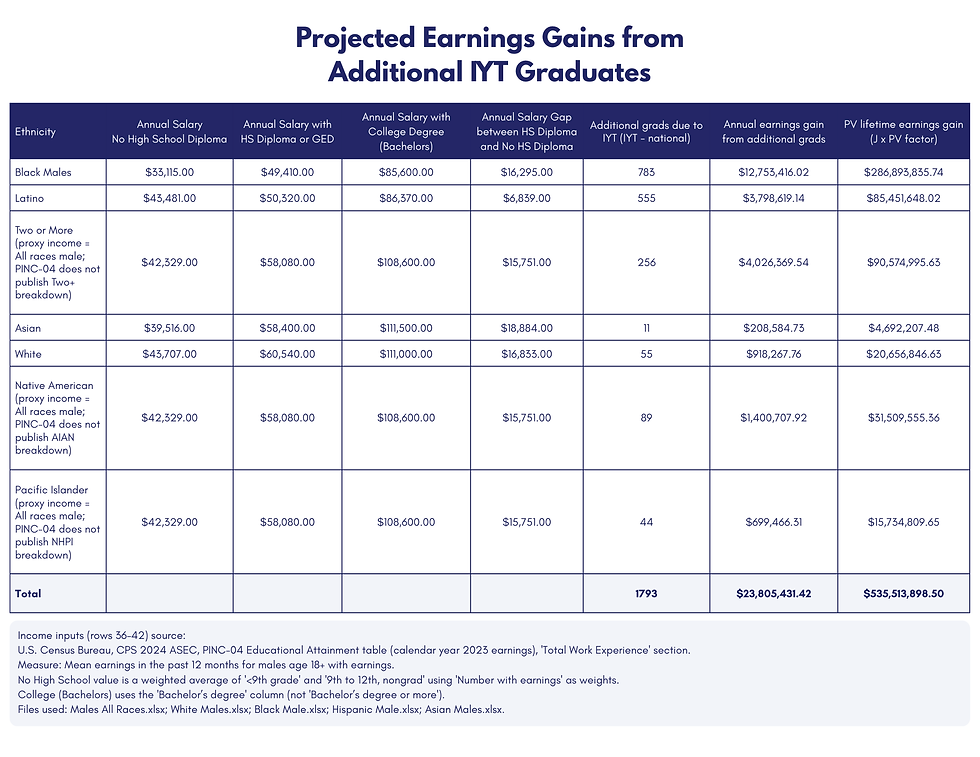
Applied to a projected cohort of more than 11,000 young men served over the next five years, the analysis indicates that IYT’s graduation outcomes would result in approximately 1,790 additional high school diplomas beyond what national graduation averages would predict.
Those additional diplomas are the core driver of the economic impact.
Using U.S. Census earnings data that reports average earnings for men by educational attainment, the analysis compares lifetime earnings for individuals who complete high school with those who do not. When the earnings gap associated with completing high school is applied to the additional graduates produced by IYT—and projected over a working lifetime using conservative discounting—the result is over $535 million in lifetime earnings gains. This reflects higher household income, increased workforce participation, and greater economic activity in local communities.
Public Cost Savings
Graduation also reduces long-term public costs (approximately $272,000 per person over their lifetime). Applying that estimate only to the incremental dropouts avoided because of IYT’s higher graduation rate—not the entire student population—the analysis estimates over $487 million in long-term taxpayer savings.
Taken together, these two effects—higher lifetime earnings and reduced public costs—generate over $1 billion in net lifetime economic value.
Scaling the System: A Time-Bound Opportunity for Philanthropic Impact
By increasing high school graduation among young men who are most at risk of falling off track, IYT generates durable economic benefits for individuals, families, communities, and the public sector.
By 2030, Improve Your Tomorrow will support over 11,000 boys and young men of color through high school, college, and into career pathways. If current outcomes hold, that support will generate over $1 billion in net lifetime economic value, through higher earnings and reduced public costs.
What makes this moment distinctive is not only the scale of impact, but its timing. IYT’s model is proven, demand for the program continues to grow, and the need to address inequities in educational and economic outcomes for young men of color has never been more urgent. Each additional cohort served compounds long-term benefits; each year of delayed investment represents missed opportunity for young people and communities alike.
Importantly, this analysis remains conservative by design. It does not include the economic benefits of college completion (where IYT maintains a 79% college-going rate), career advancement beyond high school, improved health outcomes, or intergenerational effects. Those outcomes matter deeply—but they are not required to demonstrate the strength of the case.
Improve Your Tomorrow is not a short-term intervention. It is a scalable, relationship-driven system that translates mentorship into measurable, lasting outcomes. For philanthropic partners seeking to deploy capital where evidence, equity, and long-term impact intersect, this represents a time-bound opportunity to help scale what is already working—and to shape economic outcomes for a generation of young men.
